
Most business owners I meet are convinced they’re not overpaying taxes.
They have a CPA. They file on time. They even get refunds sometimes.
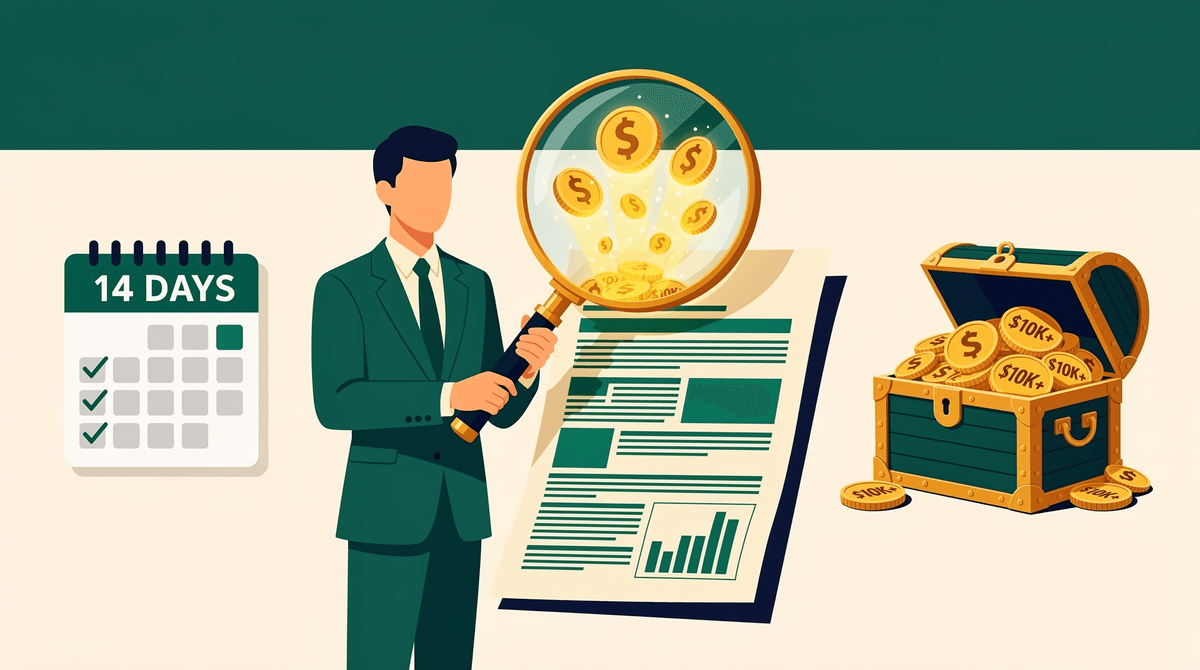
So when I tell them I guarantee $10,000+ in tax savings within 14 days (or I’ll pay them), they look at me like I’m crazy.
Then we do the analysis.
In 11 years, I’ve never had to pay out that guarantee. Not once.
Here’s exactly what we look at, what we typically find, and why most CPAs miss it.
The Difference Between Filing and Planning
Before we get into specifics, let’s establish the fundamental problem.
Your CPA is probably good at what they do. They file accurate returns. They don’t make mistakes. They answer your questions around April 15th.
But here’s the question most business owners never think to ask: When’s the last time your CPA called YOU with a tax strategy?
Not a deadline reminder. Not a “we need your documents” email. An actual strategy: a proactive recommendation that would save you money.
If the answer is “never” or “I can’t remember,” you’ve identified the problem.
Filing taxes is looking backward at what happened and reporting it correctly.
Planning taxes is looking forward at what’s coming and structuring it intelligently.
Most CPAs file. Very few plan. We break this down in depth in our Complete Guide to Proactive Tax Planning.
That gap is where I find the $10,000+.
What the 14-Day Analysis Looks Like
When a business owner takes me up on the guarantee, here’s exactly what happens:
Days 1–3: Information Gathering
We collect:
- Last 2–3 years of tax returns
- Current year P&L and balance sheet
- Entity structure documents (LLC operating agreements, S-Corp election letters)
- Retirement plan details
- Equipment and vehicle schedules
- Owner compensation breakdown
This isn’t a complicated process. Most business owners have these documents. They’re just sitting in a folder somewhere, never getting analyzed.
Days 4–10: The Deep Dive
This is where I spend my time. I’m looking at five core areas:
1. Entity Structure
- Are you the right entity type for your income level?
- When’s the last time someone reviewed this?
- Are there opportunities to restructure?
2. Owner Compensation
- Is your salary/distribution split optimized?
- Are you leaving FICA on the table?
- Does your compensation structure match your actual work?
3. Retirement Vehicles
- Are you maxing out what’s available?
- Is there a better structure than your current 401(k)?
- What about defined benefit plans for high-income owners?
4. Depreciation Strategy
- Are you using Section 179 and Bonus Depreciation correctly?
- Is your timing optimized?
- Are vehicles structured properly?
5. Deduction Capture
- What’s being missed?
- Are business use percentages accurate?
- Are there industry-specific deductions being overlooked?
Days 11–14: Presentation
I put together a document that shows:
- Exactly what I found
- The dollar value of each opportunity
- What it would take to implement
- The timeline for realizing savings
If the total is less than $10,000, I pay you. Simple as that.
What I Actually Find (Real Examples)
Let me give you specific examples from recent analyses. I’ve changed identifying details, but the dollar amounts are real.
Texas Contractor: $28,000 in Year One
This was a general contractor doing about $3M in revenue, similar to the situation we describe in The Contractor Who Lost $200K Because Nobody Tracked Job Costs. He’d had the same CPA for 8 years. Good relationship, trusted advisor.
Here’s what we found:
- Entity restructure: He was running everything through a single-member LLC. We set up an S-Corp election and optimized his salary. Savings: $11,400/year
- Equipment depreciation timing: He was buying equipment in January. We shifted purchases to December and used 100% bonus depreciation. Savings: $8,200 in year one
- Work truck structure: His trucks were being depreciated over 5 years. With proper classification, we accelerated it. Savings: $4,800
- Home office: He had a legitimate home office but wasn’t claiming it, one of the most common bookkeeping mistakes that cost you at tax time. Savings: $3,600/year
Total first-year impact: $28,000.
His CPA wasn’t bad. His CPA just wasn’t looking.
Dental Practice Owner: $34,000 Annually
This was a dentist with a single practice, about $1.8M in production. Two associates, four hygienists.
What we found:
- Associate compensation structure: The way he was paying associates created unnecessary tax liability. Restructured to profit-sharing arrangement. Savings: $12,000/year
- Retirement vehicle upgrade: He was maxing out a SEP-IRA. We implemented a defined benefit plan. Additional deduction: $87,000/year, tax savings: $15,000/year
- Equipment depreciation: Same story. Not using 100% bonus depreciation on recent purchases. Savings: $7,000
Total ongoing impact: $34,000 annually.
Medical Practice: $18,000 Found
A physician group with three partners. They assumed their CPA was handling everything because they were paying premium fees.
Findings:
- Entity structure: Operating as a general partnership instead of S-Corp. Nobody had reviewed this since they started 12 years ago. Savings: $9,500/year
- Vehicle deductions: Partners were using personal vehicles for work and not tracking properly. With mileage logs: Savings: $4,800/year
- Retirement optimization: Similar to the dental case. Moved from 401(k) to combined defined benefit. Savings: $3,700/year
Why CPAs Miss This
I want to be clear: I’m not saying CPAs are bad. Most are technically excellent.
The problem is the business model.
A typical CPA firm makes money by filing as many returns as possible as efficiently as possible. They charge by the return or by the hour. Their peak season is January through April. The rest of the year, they’re doing bookkeeping and payroll.
Tax planning requires proactive outreach. It requires calling clients in September to discuss strategy. It requires staying current on depreciation rules and entity strategies. It requires making recommendations before year-end, not after.
That’s not how most CPA firms operate. Not because they’re lazy, but because their business model doesn’t reward it.
I built Today CFO differently. We’re not trying to serve 500 clients with a lean staff during busy season. We work with fewer clients, more deeply, year-round.
That’s the difference.
The $10K Guarantee: Why I Offer It
People ask me all the time: “Why would you guarantee $10,000? What if you’re wrong?”
Here’s the truth: The guarantee is easy because I’m almost never wrong.
After 11 years and hundreds of analyses, I know what to look for. I can usually tell within the first hour whether a business owner is overpaying. By the time I’ve spent a few hours on the deep dive, I know exactly where the money is.
The guarantee isn’t a risk for me. It’s a risk-elimination for you.
You don’t have to trust my marketing. You don’t have to take my word for it. You don’t have to wonder if I’m exaggerating.
Either I find $10,000+ in savings, or I pay you.
What’s the worst case? You learn you’re actually optimized, and you get paid for your time. That’s never happened, but if it did, at least you’d have peace of mind.
What’s the likely case? I find money you didn’t know you were leaving on the table, and you end up with five or six figures in savings over the next few years.
Who This Is For (And Who It’s Not)
This analysis works best for:
- Business owners with $500K+ in revenue. Below that threshold, the savings opportunities are smaller. If you’re in this range, you may also want to consider when to hire a part-time CFO
- Owners who haven’t reviewed their tax strategy in 2+ years. The longer it’s been, the more likely there’s something to find
- Anyone who feels like they’re “just filing” at tax time. If you can’t name a specific strategy your CPA recommended in the last year, that’s a red flag
- Practice owners (medical, dental, legal, construction). These industries have specific deductions and structures that are often overlooked
This is probably NOT for you if:
- You already work with a CFO or tax strategist (not just a CPA)
- Your CPA calls you quarterly with proactive recommendations
- You’ve done a full review in the last 12 months
What Happens After the Analysis
If I find the savings (and I will), you have a few options:
Option 1: Take the findings and implement with your current CPA. I’ll give you everything you need. No hard feelings.
Option 2: Work with us to implement. We become your ongoing tax planning and CFO partner. Most clients choose this because they want someone proactive in their corner going forward.
Option 3: Do nothing. Some people get the analysis, see the savings, and never act. That’s their choice. (Though I’ll never understand leaving $10K+ on the table.)
The point is: there’s no commitment beyond the analysis. I find the money. What you do with it is up to you.
The Bottom Line
Most business owners overpay because their CPA files returns but doesn't plan strategy. The gap between filing and planning is where we find $10,000+ every time. In 11 years and hundreds of analyses, we've never failed to find it.

About the Author
Tom Woolley, MBA
Tom Woolley is a fractional CFO who has spent 11+ years helping business owners take control of their finances. He works with contractors, dental and medical practices, and professional service firms across the country.
Connect on LinkedInReady to Find Out What You're Missing?
Book a 15-minute call to see if you're a good fit for our 14-Day Tax Analysis. We'll find $10,000+ in savings, or we pay you $500.
Schedule Your Assessment